
Role of AI in Society, Education, and Health

 Research in this axis examines how AI influences information dissemination, social behavior, learning environments, and health outcomes.

Research in this axis examines how AI influences information dissemination, social behavior, learning environments, and health outcomes.
 Research in this axis investigates how humans reason about AI systems, how they interpret machine behavior, and how misunderstandings or biases can arise during interaction.
 Research in this axis uses AI to analyze naturalistic data such as speech, text, behavior, and neural activity.
 Historically, insights about human learning, decision making, and representation have played a major role in the development of AI, from early expert systems to reinforcement learning and modern deep neural architectures. This tradition continues today.
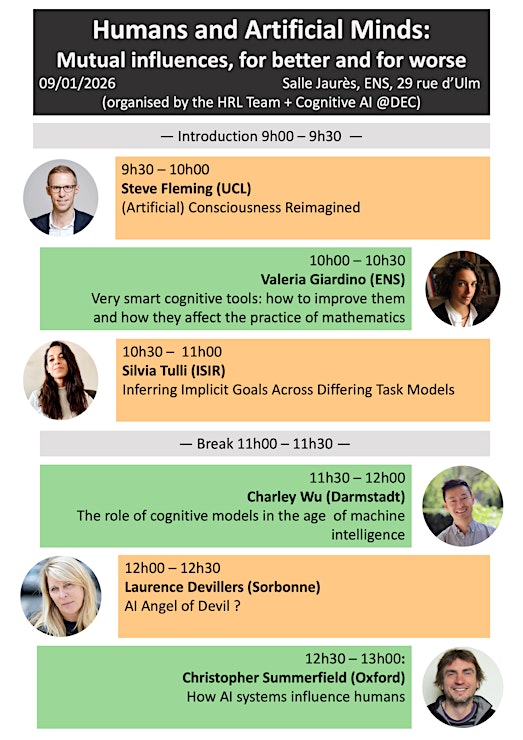
Symposium on AI and Cognition discussing the impact of AI on our societies and how it reshapes the field of cognitive sciences.
Et si l’analyse linguistique aidait à sauver des vies ? Alda Mari, directrice de recherche à l’Institut Jean Nicod, est une spécialiste de la sémantique formelle.
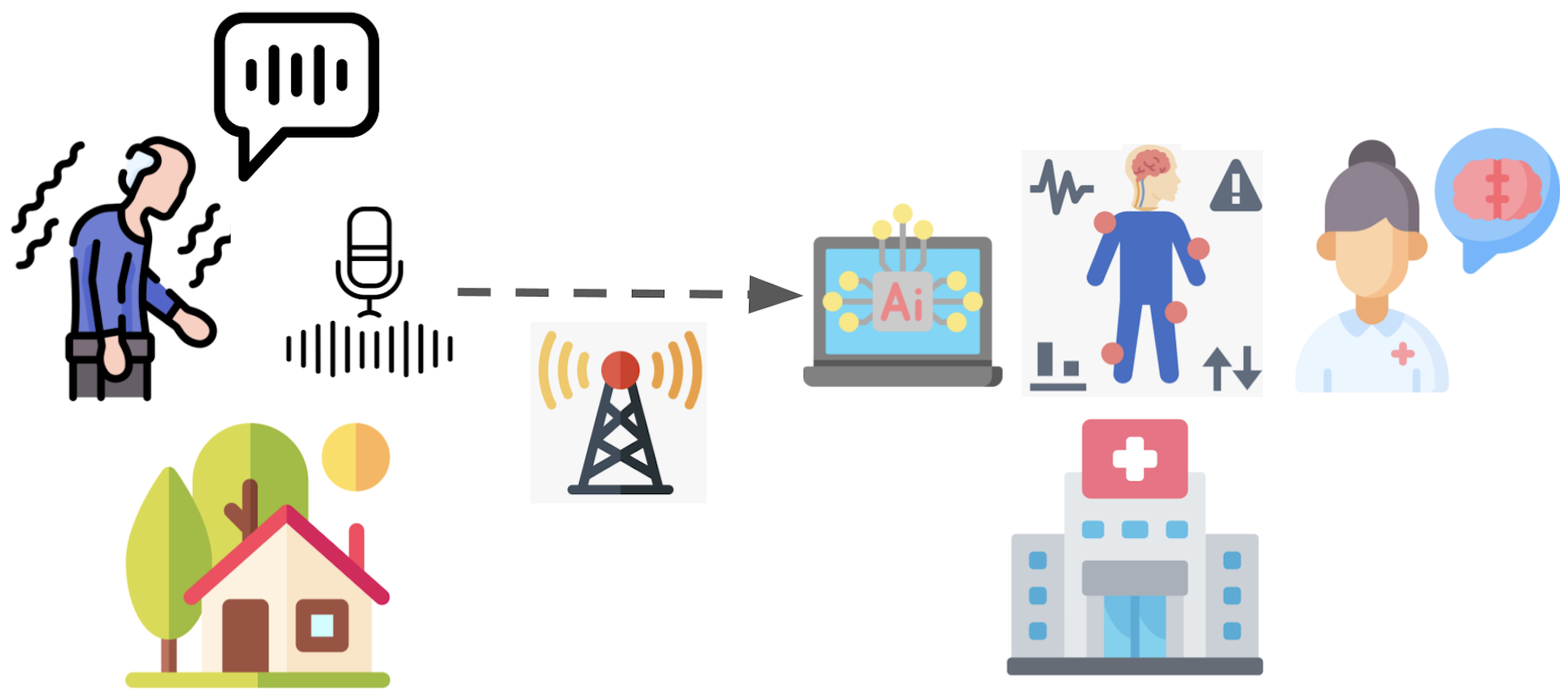 Le suivi de l’évolution de la maladie de Parkinson est complexe car les évaluations actuelles sont souvent coûteuses, longues, et en partie subjectives.
À l’occasion du Sommet pour l'Action sur l'intelligence artificielle (IA) qui se tiendra en France les 10 et 11 février 2025 - et dont l’ENS accueillera le mardi 11 les « side events » dédiés à l’IA et la société – Daniel Andler, mathématicien et philosophe des sciences, nous éclaire sur les origines et les avancées de l’IA, en rappelant que même si l’intelligence artificielle ne cesse de progresser, il n’y a pas de raison de penser voir un jour un système dont l’intelligence serait comparable à celle des êtres humains.
CREativité et imaginaTION par le prisme de l’Intelligence Artificielle
La créativité est un outil puissant pour faire face au monde et le changer. L'intérêt des scientifiques pour la créativité est de plus en plus important.
Comment notre cerveau s’adapte-t-il à une situation imprévue ? S’il n’y a jamais été confronté auparavant et n’a pas de retour d’expérience pour favoriser un choix plutôt qu’un autre, comment parvient-il à prendre une décision ? Pour donner un exemple concret : que faire quand son métro ou son bus n’arrive pas et que les informations communiquées par oral ou sur les tableaux d’affichage sont vagues ?